Space Humanity Program

Search
Interorbital Systems
Read in another languageWatch this pageEdit
Interorbital Systems Corporation (IOS) is an American aerospace manufacturer active in Mojave, California. It was founded in 1996 by Roderick and Randa Milliron,[1] who also co-founded[when?] Trans-Lunar Research, a non-profit organization.[not verified in body]. They aim to develop a low-cost launch vehicle for commercial purposes, by using non-aerospace components whenever possible to keep the cost down.
Interorbital Systems Corporation IndustryAerospaceFounded1996HeadquartersMojave, California
Key people
Rod Milliron and Randa Milliron (founders)Productsrocket engines, rocket launch
Number of employees
12 [1]Websitehttp://www.interorbital.com/
Interorbital Systems was engaged in developing a launch vehicle for the Google Lunar X Prize Team Synergy Moon[2] and for commercial launches. The company was also a competitor in the Ansari X Prize[3] and America's Space Prize.[4]
Research and developmentEdit
Interorbital Systems is developing its NEPTUNE line of launch vehicles[5][1] that would launch payloads into orbit from sea platforms.[citation needed]
In 2016, the company website indicated they build their rockets using off-the-shelf, non-aerospace components whenever possible to keep the cost down.[1] As of 2016, the NEPTUNE system was to be Interorbital System's line of launch vehicles built from varying configurations of the Common Propulsion Module.[6]
Common Propulsion ModuleEdit
As of 2011, all of Interorbital's rocket designs were based on the Common Propulsion Module (CPM). The CPM was slated to be a small, self-contained rocket system capable of delivering a 145 kg payload to an altitude of 310 km in a suborbital flight. Multiple CPMs are combined through parallel staging to meet varying mission requirements. Though they have experimented with cryogenic fuel, Interorbital used hypergolic white fuming nitric acid and Turpentine for oxidizer and fuel. The CPM is designed to maximize simplicity - its propellants are hypergolic and pressure fed, respectively eliminating the need for ignition and turbopump systems.[7]
Sounding rocketsEdit
Interorbital Systems has tested a number of rocket engines in the 500-5,000 lbf (2 to 22 kN) thrust range and conducted flight tests of its small testbed, Neutrino.[when?] Neutrino is a sounding rocket designed for low-altitude suborbital flight, for the purpose of testing systems of its larger follow-on rockets.[citation needed]
In 2006, IOS had an active Office of Commercial Space Transportation launch license for Tachyon,[8] a sounding rocket designed for a 120-mile apogee suborbital flight.
Preliminary design conceptsEdit
Solaris: an early-2000s suborbital rocket design that was initially IOS' attempt to win the Ansari X Prize. It was not finished in time and was beaten by Scaled Composites' SpaceShipOne.[9]
MilestonesEdit
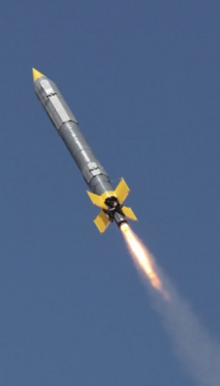


Test flight of the single CPM on March 29th, 2014 with four payloads on board.
The CPM's main engine underwent its first successful static engine firing on October 28, 2012. The all composite-chambered engine performed with 7,500lbs of thrust, using nitric acid and turpentine.[citation needed]The Common Propulsion Module Test Vehicle (CPM TV) performed its first successful test flight on March 29, 2014.[10]The payloads included two CubeSats, a Synergy Moon payload and a music CD by "ENCLOSURE" by former Red Hot Chili Peppers guitarist, John Frusciante.[11] The rocket reached an altitude of 10,000 feet and will be reused for the next test flight. All payloads were recovered intact.[10]
Satellite kitsEdit
CubeSat Personal Satellite Kit comes in both a standard 1 kg (2.2 lb) and a non-standard 1.33 kg (2.93 lb) configuration. Built of an aluminum frameDesigned for simple experiments, receiving and transmitting radio signals, or for personal use.TubeSat Personal Satellite Kit, a lower-cost alternative to CubeSats built wholly of printed circuit boards.
They claim that kits will be launched into 310 km (192 mi) self-decaying orbits where they will eventually burn up in the Earth's atmosphere.[citation needed] They have a large launch manifest for both kinds of launches.[12][non-primary source needed]
Google Lunar XPrizeEdit
Interorbital Systems is engaged in June 2016 as a member of and launch provider for Team Synergy Moon in the Google Lunar X Prizecompetition.[13][14] The team's lunar rover was to have been lifted to the Moon's surface by a modified, 36-module version of the NEPTUNE rocket.[citation needed]
Comments
Post a Comment